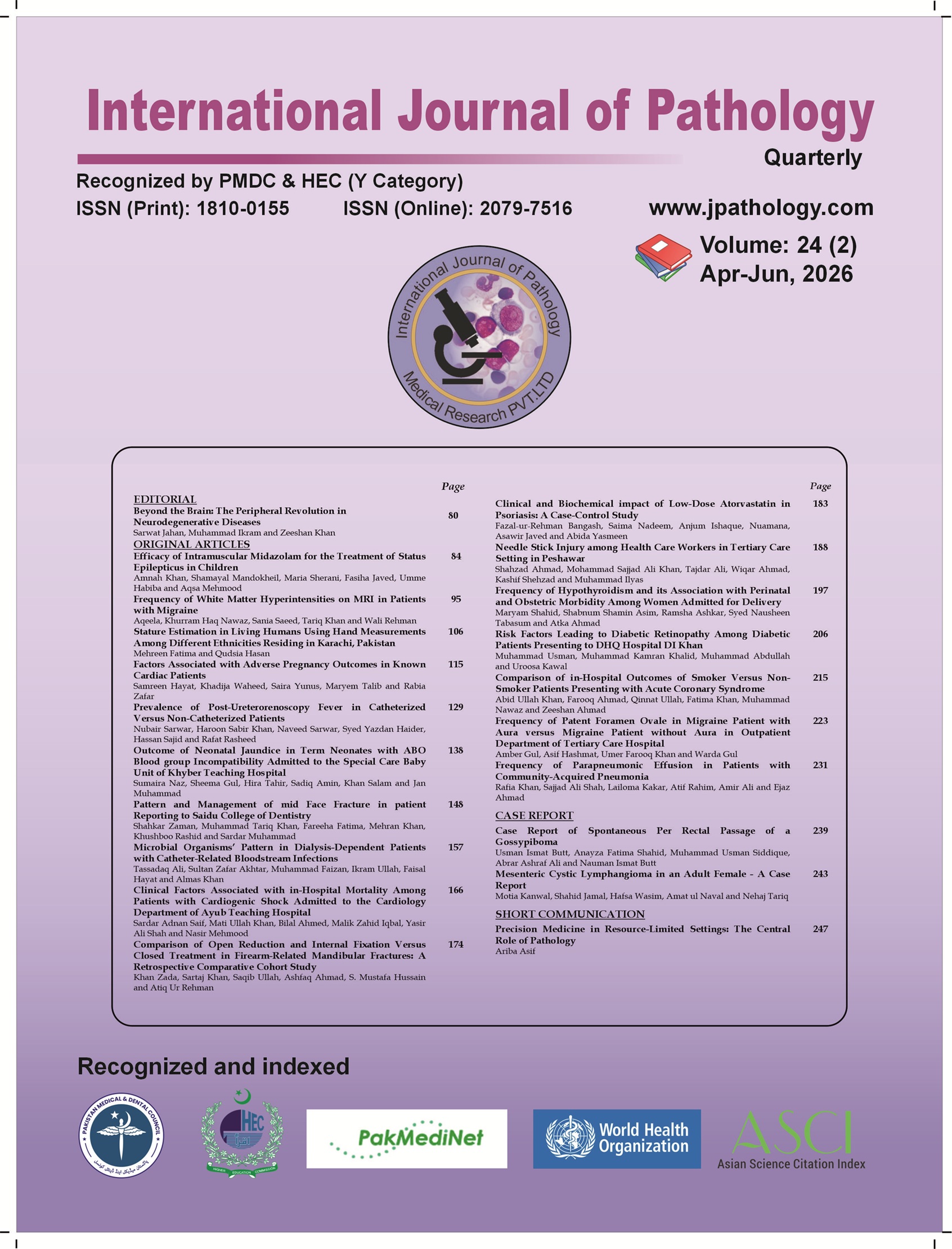
Factors associated with adverse pregnancy outcomes in known cardiac patients
DOI:
https://doi.org/10.59736/IJP.24.02.1095Keywords:
Delayed Diagnosis, Maternal Mortality, Pregnancy, Rheumatic Heart DiseaseAbstract
Background: Cardiac disease is a major cause of maternal illness and death during pregnancy. The burden is especially high in regions with limited healthcare resources, where delayed diagnosis and poor access to care increase the risk of adverse outcomes. Objective was to assess the frequency of adverse outcomes and factors related to maternal adverse outcomes in pregnant cardiac patients.
Methods: This descriptive case series was carried out in the Department of obstetrics and gynecology, services hospital, Lahore, from December 2025 to February 2026. A total of 100 pregnant women with cardiac disease beyond 16 weeks of gestation were included. Demographic, obstetric, and clinical data including type of cardiac disease, New York Heart Association (NYHA) functional class, and treatment history were recorded along with maternal and fetal outcomes. Data were analyzed using SPSS version 21. Associations between variables and outcomes were assessed using the chi-square test, with statistical significance set at p < 0.05.
Results: The mean age was 29.17 ± 4.91 years, mean gestational age 32.54 ± 3.29 weeks, and mean BMI 27.11 ± 3.33 kg/m². Rheumatic heart disease was most common (38%). Stillbirth (64%) and maternal mortality (57%) were the major adverse outcomes. ICU admission was 21% and prolonged hospital stay 22%. Outcomes were significantly associated with age, BMI, gestational age, parity, booking status, and socioeconomic factors (p < 0.05). High-risk groups included younger, prim gravida, normal BMI, and un-booked patients.
Conclusion: Pregnant women with cardiac disease face high rates of maternal mortality (57%) and stillbirth (64%), influenced by factors such as maternal age, BMI, parity, booking status, and socioeconomic conditions. Early detection and timely intervention can improve outcomes.
References
Park K. Pregnancy history is critical in our female patients. Cardiovasc Innov Appl. 2024; 9:972. doi: https://doi.org/10.15212/CVIA.2024.0014
Yang Y, Lewey J, Arany Z. Cardiovascular complications of pregnancy. J Clin Invest. 2026;136(1). doi: https://doi.org/10.1172/JCI198808
Parikh NI, Gonzalez JM, Anderson CAM, Judd SE, Rexrode KM, Hlatky MA, et al. Adverse Pregnancy Outcomes and Cardiovascular Disease Risk: Unique Opportunities for Cardiovascular Disease Prevention in Women: A Scientific Statement from the American Heart Association. Circulation. 2021;143(18): e902–e916. https://doi.org/10.1161/CIR.0000000000000961
Philippe A, Orango EO, Mwangi A, Barasa F. Factors Related to Maternal Adverse Outcomes in Pregnant Women with Cardiac Disease in Low-resource Settings. EuropeanCardiology Review. 2020;15. https://www.ecrjournal.com/articles/factors-related-maternal-adverse-outcomes-pregnant-women-cardiac-disease-low-resource-settings
O’Kelly AC, Michos ED, Shufelt CL, Vermunt JV, Minissian MB, Quesada O, et al. Pregnancy and Reproductive Risk Factors for Cardiovascular Disease in Women. CirculationResearch.2022;130(4):652–62. https://doi.org/10.1161/CIRCRESAHA.121.319895
Sondergaard MM, Hlatky MA, Stefanick ML, Vittinghoff E, Nah G, Allison M, et al. Association of Adverse Pregnancy Outcomes with Risk of Atherosclerotic Cardiovascular Disease in Postmenopausal Women. JAMA Cardiology. 2020;5(12):1390–8. https://doi.org/10.1001/jamacardio.2020.3682
Grandi SM, Filion KB, Yoon S, Ayele HT, Doyle CM, Hutcheon JA, et al. Cardiovascular Disease–Related Morbidity and Mortality in Women with a History of Pregnancy Complications: Systematic Review and Meta-analysis. Circulation. 2019;139(8):1069–79. https://doi.org/10.1161/CIRCULATIONAHA.118.036748
Crump C, Sundquist J, Howell EA, McLaughlin MA, Stroustrup A, Sundquist K. Preterm Delivery and Risk of Ischemic Heart Disease in Women. Journal of the AmericanCollegeofCardiology.;76(1):57–67. https://doi.org/10.1016/j.jacc.2020.05.056
Shrestha P, Kuikel S, Bajracharya S, Ghimire A, Shrestha R, Mishra A, et al. Pregnancy with heart disease in South Asia: a systematic review and meta-analysis of prevalence and outcome. Ann Med Surg (Lond). 2022; 80:104293. doi: https://doi.org/10.1016/j.amsu.2022.104293
Poli PA, Orango EO, Mwangi A, Barasa FA. Factors Related to Maternal Adverse Outcomes in Pregnant Women with Cardiac Disease in Low-resource Settings. European Cardiology. 2020;15: e68. https://www.ecrjournal.com/articles/factors-related-maternal-adverse-outcomes-pregnant-women-cardiac-disease-low-resource-settings
Joseph KS, Lisonkova S, Boutin A, Muraca GM, Razaz N, John S, et al. Maternal mortality in the United States: are the high and rising rates due to changes in obstetrical factors, maternal medical conditions, or maternal mortality surveillance? Am J Obstet Gynecol. 2024;230(4): 440.e1-440.e13. doi: https://doi.org/10.1016/j.ajog.2023.12.038. PMID: 38480029.
Banerjee Y, Kansaria HJ. Effect of body mass index (BMI) and weight changes during gestation on perinatal and maternal outcome: a prospective observational study [preprint]. 2025 May 9. doi: https://doi.org/10.21203/RS.3.RS-6437411/V1
Lee SU, Park JY, Hong S, Wie JH, Shin JE, Choi SK, et al. Risk factors for pregnancy-associated heart failure with preserved ejection fraction and adverse pregnancy outcomes: a cross-sectional study. BMC Pregnancy Childbirth. 2024;24(1):211. doi: https://doi.org/10.1186/S12884-024-06402-5 PMID: 38509461
Lewey J, Beckie TM, Brown HL, Brown SD, Garovic VD, Khan SS, et al. Opportunities in the postpartum period to reduce cardiovascular disease risk after adverse pregnancy outcomes: a scientific statement from the American Heart Association.Circulation.2024;149(7):E330-E346. doi: https://doi.org/10.1161/CIR.0000000000001212
Afridi JR, Jan SA, Asif MF. Assessing inequality of opportunity in access to maternal healthcare services in Pakistan: a quantitative attempt. BMC Health Serv Res. 2025;25(1):1167. doi: https://doi.org/10.1186/S12913-025-13312-5 .
Verbeke M, Hannes L, Devriendt K, Van den Bogaert K, Cools B, De Catte L, et al. Chromosomal analysis and short-term outcome of prenatally diagnosed congenital heart disease. Sci Rep. 2025;15(1):3923. doi: https://doi.org/10.1038/s41598-025-88570-8. PMID: 39890866.
Mathesan M, Kirubamani H. Unveiling the spectrum of cardiac disease complicating pregnancy: a comprehensive exploration of maternal and fetal outcomes. Indian J Obstet Gynecol Res. 2025;11(2):152–6. doi: https://doi.org/10.18231/j.ijogr.2024.032 Li B, Wang Y, Chen R. Delivery-related maternal morbidity and mortality among patients with cardiac disease. Obstet Gynecol. 2025;145(3): e124. doi: https://doi.org/10.1097/AOG.0000000000005836. PMID: 39977866.
Ilić A, Tadić S, Stefanović M, Ilić D, Petrović M, Milovančev A, et al. Impact of three-dimensional assessment of maternal left ventricular systolic function on pregnancy outcomes.RevCardiovascMed. 2025;26(4). doi: https://doi.org/10.31083/RCM27639
Avila Samuel W, Lucena AJG, Freire CMV, Silva FB, Rivera IR, Oliveira JR, et al. Causes and predictors of maternal mortality in pregnant women with heart disease: data from the Brazilian Pregnancy and Heart Disease Registry (REBECGA-Trial). EurHeartJ.2025;46(Suppl1):ehaf784.4161.doi:https://doi.org/10.1093/eurheartj/ehaf784.4161.
Lindley KJ, Bairey Merz CN, Asgar AW, Bello NA, Chandra S, Davis MB, et al. Management of women with congenital or inherited cardiovascular disease from pre-conception through pregnancy and postpartum: JACC Focus Seminar 2/5. J AmCollCardiol.2021;77(14):1778-1798.doi: https://doi.org/10.1016/j.jacc.2021.02.026. PMID: 33832605.
Marium A, Abbas SO, Jaskani H, Shahwar DE, Baloch F. Cardiovascular disease in pregnancy: challenges, care and collaboration in low- and middle-income countries.JAsianPacSocCardiol.2025Dec4. doi:https://doi.org/10.15420/JAPSC.2025.06.
Rehman M, Ghaffar S, Nawaz Q, Gul U, Ashfaq T, Tabassum H. Impact of different BMIs on fetomaternal outcome as compared to control group BMIs. Biol Clin Sci Res J. 2025;6(5):42-45. doi: https://doi.org/10.54112/BCSRJ.V6I5.1735.
Anh NTH, Thang NM, Huong TT. Maternal and perinatal outcomes of hypertensive disorders in pregnancy: insights from the National Hospital of Obstetrics and Gynecology in Vietnam. PLoS One. 2024;19(1): e0297302. doi: https://doi.org/10.1371/journal.pone.0297302. PMID: 38295097.
Mathesan M, Kirubamani H. Unveiling the spectrum of cardiac disease complicating pregnancy: a comprehensive exploration of maternal and fetal outcomes. Indian J Obstet Gynecol Res. 2025;11(2):152–6. doi: https://doi.org/10.18231/j.ijogr.2024.032
Li B, Wang Y, Chen R. Delivery-related maternal morbidity and mortality among patients with cardiac disease. Obstet Gynecol. 2025;145(3): e124. doi: https://doi.org/10.1097/AOG.0000000000005836. PMID: 39977866.
Dongarwar D, Salihu HM. Place of Residence and Inequities in Adverse Pregnancy and Birth Outcomes in India. Int J MCH AIDS. 2020;9(1):53-63. doi: 10.21106/ijma.291.
Sharma G, Grandhi GR, Acquah I, Mszar R, Mahajan S, Khan SU, etal. Social Determinants of Suboptimal Cardiovascular Health Among Pregnant Women in the United States. J Am Heart Assoc. 2022 Jan 18;11(2): e022837. doi: 10.1161/JAHA.121.022837.
Published
Issue
Section
License
Copyright (c) 2026 Samreen Hayat, Khadija Waheed, Saira Yunus, Maryem Talid, Rabia Zafar

This work is licensed under a Creative Commons Attribution-NonCommercial 4.0 International License.
Readers may “Share-copy and redistribute the material in any medium or format” and “Adapt-remix, transform, and build upon the material”. The readers must give appropriate credit to the source of the material and indicate if changes were made to the material. Readers may not use the material for commercial purpose. The readers may not apply legal terms or technological measures that legally restrict others from doing anything the license permits.