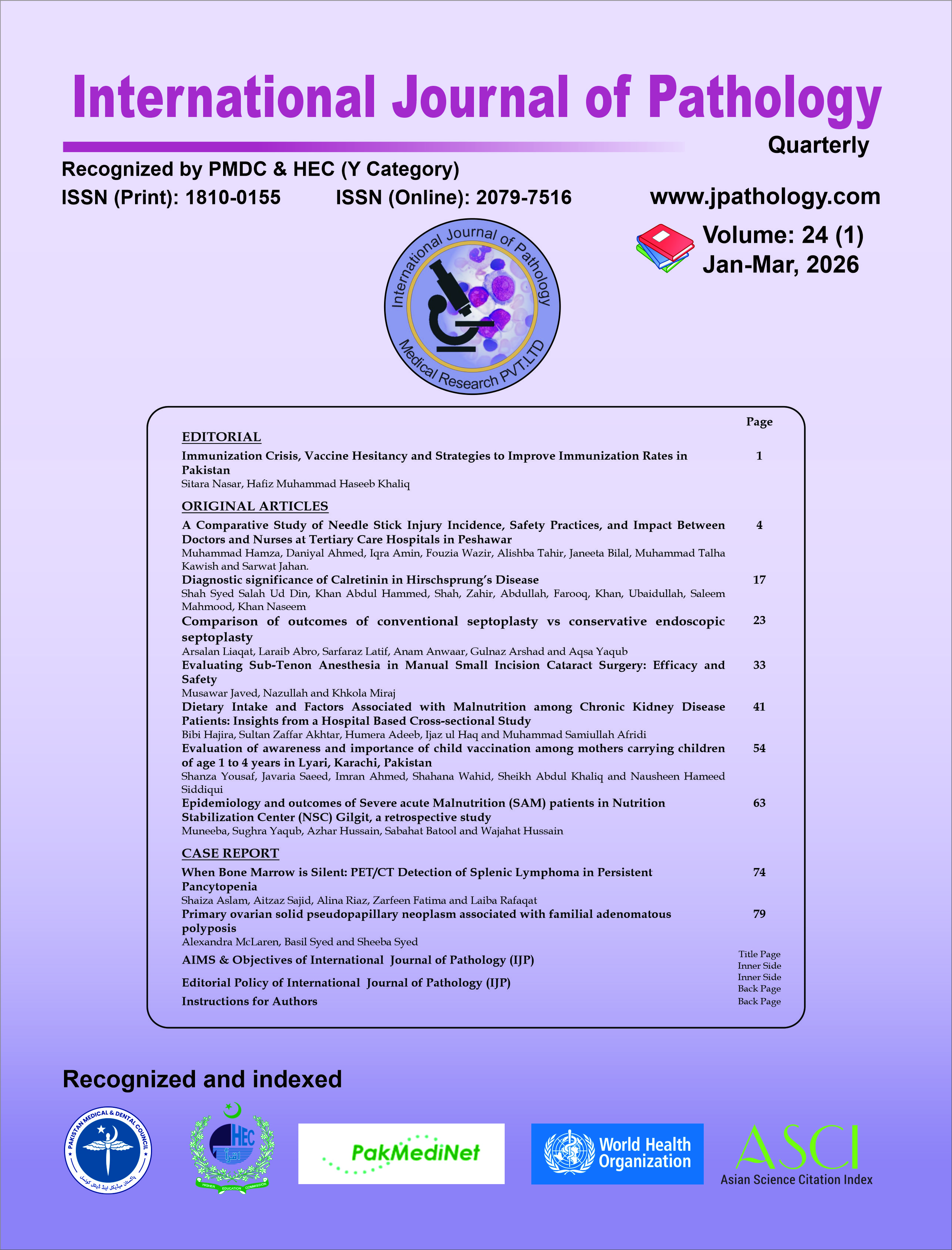
Epidemiology and outcomes of severe acute malnutrition (SAM) patients in Nutrition Stabilization Center (NSC) Gilgit, a retrospective study
DOI:
https://doi.org/10.59736/IJP.24.01.994Keywords:
MUAC, Severe Acute Malnutrition, Treatment Outcomes, Weight GainAbstract
Background: Severe Acute Malnutrition (SAM) is a critical health issue in Pakistan, particularly in remote regions like Gilgit-Baltistan, due to remoteness, lack of health facility and awareness. Our primary objective is to assess the epidemiology and treatment outcomes of patients with Severe Acute Malnutrition (SAM) admitted to the Nutrition Stabilization Center (NSC) at the Provincial Headquarters Hospital, Gilgit. The study aims to identify key socio-demographic and underlying risk factors influencing the occurrence and progression of SAM in the region.
Methods: We examine 226 children's medical records who were admitted with severe acute malnutrition (SAM). Demographic information, anthropometric measurements (weight, Mid Upper Arm Circumference MUAC), health issues, treatment plans, and dietary management techniques were all included in the data., RUTF, ReSoMal, F-75, and F-100 were the therapeutic foods. Treatment results and the length of hospital stay were additional variables. Advanced statistical analyses were carried out using Statistix 8.1. Using age-group stratification, the anthropometric and clinical indicator values at admission and discharge were compared to evaluate nutritional recovery.
Results: Nearly half of the patients were from Gilgit (48.7%), with most referred via OPD (94.2%). Non-oedematous SAM was predominant (94.7%) and new admissions accounted for 95.1%. Common complications included acute gastroenteritis (53.1%), lower respiratory tract infections (22.1%) and sepsis (8.8%). All children received F-75, with variations in additional therapeutic interventions. Mean hospital stay was 8.04 ± 3.30 days, and the cure rate was 91.6%. Significant improvements in weight and MUAC were observed. Children aged 6–10 months showed the highest mean weight gain (0.51 kg), whereas those aged 26–30 months recorded the highest mean MUAC gain (+0.53 cm).
Conclusion: SAM management demonstrated positive outcomes, with over 91% recovery and significant anthropometric improvements. Younger children exhibited better weight recovery, while older children showed greater MUAC improvement.
References
World Health Organization. Malnutrition. Geneva: World Health Organization; 2024 https://www.who.int/healthtopics/malnutrition.
World Health Organization. WHO child growth standards and the identification of severe acute malnutrition in infants and children: joint statement by the World Health Organization and the United Nations Children’s fund. Geneva: World Health Organization; 2009.
World Health Organization. Guideline: updates on the management of severe acute malnutrition in infants and children. Geneva: World Health Organization; 2013.
Alou MT, Golden MH, Million M, Raoult D. Difference between kwashiorkor and marasmus:comparative meta-analysis of pathogenic characteristics and implications for treatment. MicrobPathog.2021;150:104702.
World Health Organization. Updates on the management of severe acute malnutrition in infants and children. Geneva: World Health Organization;2013
https://www.who.int/publications/i/item/9789241506328
World Health Organization. Malnutrition in children. Geneva: World Health Organization.Availablefrom: https://www.who.int/data/nutrition/nlis/info/malnutrition-in-children
UNICEF. The state of the world’s children 2019: children, food and nutrition. New York: UNICEF; 2019.
Shanka N, Lemma S, Abyu D. Recovery rate and determinants in treatment of children with severe acute malnutrition using outpatient therapeutic feeding program in Kamba District, Southwest Ethiopia. J Nutr Disord Ther. 2015;5(2):155.
Desyibelew HD, Fekadu A, Woldie H. Recovery rate and associated factors of children age 6 to 59 months admitted with severe acute malnutrition at inpatient unit of Bahir Dar Felege Hiwot referral hospital therapeutic feeding unite, Northwest Ethiopia. PLoS One. 2017;12(2): e0171020. https://doi.org/10.1371/journal.pone.0171020.
UNICEF, WHO, World Bank. Joint Child MalnutritionEstimates2023. https://data.unicef.org/resources/jme-report-2023/UNICEF DATA
Government of Pakistan, Ministry of National Health Services, Regulations & Coordination, UNICEF. National Nutrition Survey 2018: Key findings report. Islamabad: Government of Pakistan; 2019.
Ahmed N, Umar F, Saleem F, Iqbal Q, Haider S, Bashaar M. Treatment outcomes of severe acute malnutrition and its determinants among paediatric patients in Quetta City, Pakistan. J Multidiscip Healthc. 2023:2809–21.
Najar BA, Bhat MA, Rather ZE, Sheikh MA. Demographic and clinical profile of children with severe acute malnutrition: an experience from nutritional rehabilitation center in South Kashmir. Int J Contemp Pediatr. 2021;8(8):1418.
Kumar R, Singh J, Joshi K, Singh HP, Bijesh S. Comorbidities in hospitalized children with severe acute severe malnutrition. Indian Pediatr. 2014;51(2):125-7.
Choudhary M, Sharma D, Nagar RP, Dutt B, Nagar T, Pandita A. Clinical profile of severe acute malnutrition in western Rajasthan: A prospective observational study from India. J Pediatr Neonat Care. 2045;2(1):00057
Verma DK, Varghese A, Agarwal M, Singh VK, Chandrakanta C. Outcome of nutritional rehabilitation center-based care for children with severe acute malnutrition in Uttar Pradesh, India: cross sectional Study. Int J Health Allied Sci. 2022;11(1):3.
Mezemir M, Girma M, Bekele D. Treatment outcome and associated factors of acute malnutrition among children in therapeutic feeding centers in Addis Ababa, Ethiopia. Pediatr Health Med Ther. 2022; 13:145–54.
Sharma SD, Sharma P, Jamwal A, Saini G. Profile of children with severe acute malnutrition. Int J Sci Study. 2019;7(2):38-42
Syed TA, Naik SA, Wasim RA, Saleem R. Demographic, clinical profile of severe acute malnutrition and our experience of nutrition rehabilitation center at children hospital Srinagar Kashmir. Int J Contemp Pediatr. 2015;2(3):233-7.
Goyal S, Agarwal N. Risk factors for severe acute malnutrition in Central India. Int J Med Sci Res Pract. 2015;2(2):70-2
Hamidu, J.L., Salami, H.A., Ekanem, A.U. and Hamman (2003) Prevalence of Protein—Energy Malnutrition in Maiduguri, Nigeria. Afr J Biomed Res. 2003; 6:123–7.
Johanna C. Factors contributing to malnutrition in children 0–60 months admitted to hospitals in the Northern Cape [thesis]. South Africa: University of the Free State; 2010.
Baskaran VM, Naaraayan SR, Priyadarshini D. Comorbidities in children hospitalized with severe cute malnutrition. Indian J Child Health. 2018;5(8):530-2.
Association S. The Sphere handbook: humanitarian charter and minimum standards in humanitarian response. Available from: https://spherestan dards.org/wp-content/uploads/Sphere-Handbook-2018-EN.pdf. Accessed June 29, 2023.
Abate BB, Tilahun BD, Kassie AM, Kassaw MW, Gurgel RQ. Treatment outcome of severe acute malnutrition and associated factors among under-five children in outpatient therapeutics unit in GubalaftoWereda, North Wollo Zone, Ethiopia, 2019. PloSOne. 2020;15(9): e0238231. doi: 10.1371/journal.pone.0238231
Joseph FI, Falade A, Earland J. Time to recovery and its predictors among children with acute malnutrition in Nigeria. J Health Popul Nutr. 2023;42(1):10.
Oumer A, Mesfin L, Tesfahun E, Ale A. Predictors of death from complicated severe acute malnutrition in East Ethiopia. Int J Gen Med. 2021; 14:8763–73.
Bitew ZW, Ayele EG, Worku T, Alebel A, Alemu A, Worku F, et al. Determinants of mortality among under-five children with severe acute malnutrition. Nutr J. 2021; 20:94.
Mandla N, Mackay C, Mda S. Prevalence of severe acute malnutrition and its effect on under-five mortality at a regional hospital in South Africa. S Afr J Clin Nutr. 2022; 35:149–54.
World Health Organization. Pocket book of hospital care for children: guidelines for the management of common childhood illnesses. 2nd ed. Geneva: World Health Organization; 2013.
Rahud M, Venkat S, Morale D, Gurav R. A trend analysis of weight gain during the nutritional recovery period of severe acute malnutrition among children. Ir J Med Sci (1971-). 2025 Apr 7:1-7.
Downloads
Published
Issue
Section
License
Copyright (c) 2026 Muneeba Ghafoor, Azhar Hussain, Sughra Yaqub, Wajahat Hussain, Sabahat Batool

This work is licensed under a Creative Commons Attribution-NonCommercial 4.0 International License.
Readers may “Share-copy and redistribute the material in any medium or format” and “Adapt-remix, transform, and build upon the material”. The readers must give appropriate credit to the source of the material and indicate if changes were made to the material. Readers may not use the material for commercial purpose. The readers may not apply legal terms or technological measures that legally restrict others from doing anything the license permits.